

Last Updated: August 11, 2026
This page provides information about the Collaboration Cycle kickoff, the first touchpoint in the Collaboration Cycle.
The kickoff is not a synchronous meeting; rather, it is a request that initiates the Collaboration Cycle process via a GitHub ticket. This ticket will be the primary source of truth for both the Governance Team and the Content and Information Architecture and Accessibility Digital Experience (ADE) teams throughout your team’s Collaboration Cycle process.
If you are building a VA Mobile App product or feature, initiate their kickoff process here.
Kickoff steps
-
Your Product Manager or another representative from your team submits a Collaboration Cycle Request, answering the kickoff questions.
-
After you submit the request, a GitHub automation will run and reformat the ticket to include required and optional touchpoints for your team. This automation should take around 15 seconds.
-
Once the kickoff request automation has completed and touchpoints have been assigned, you are ready to move to the next touchpoint. Content and Information Architecture and ADE teams may also reach out to you to assess your needs for collaboration on content, IA, and accessibility.
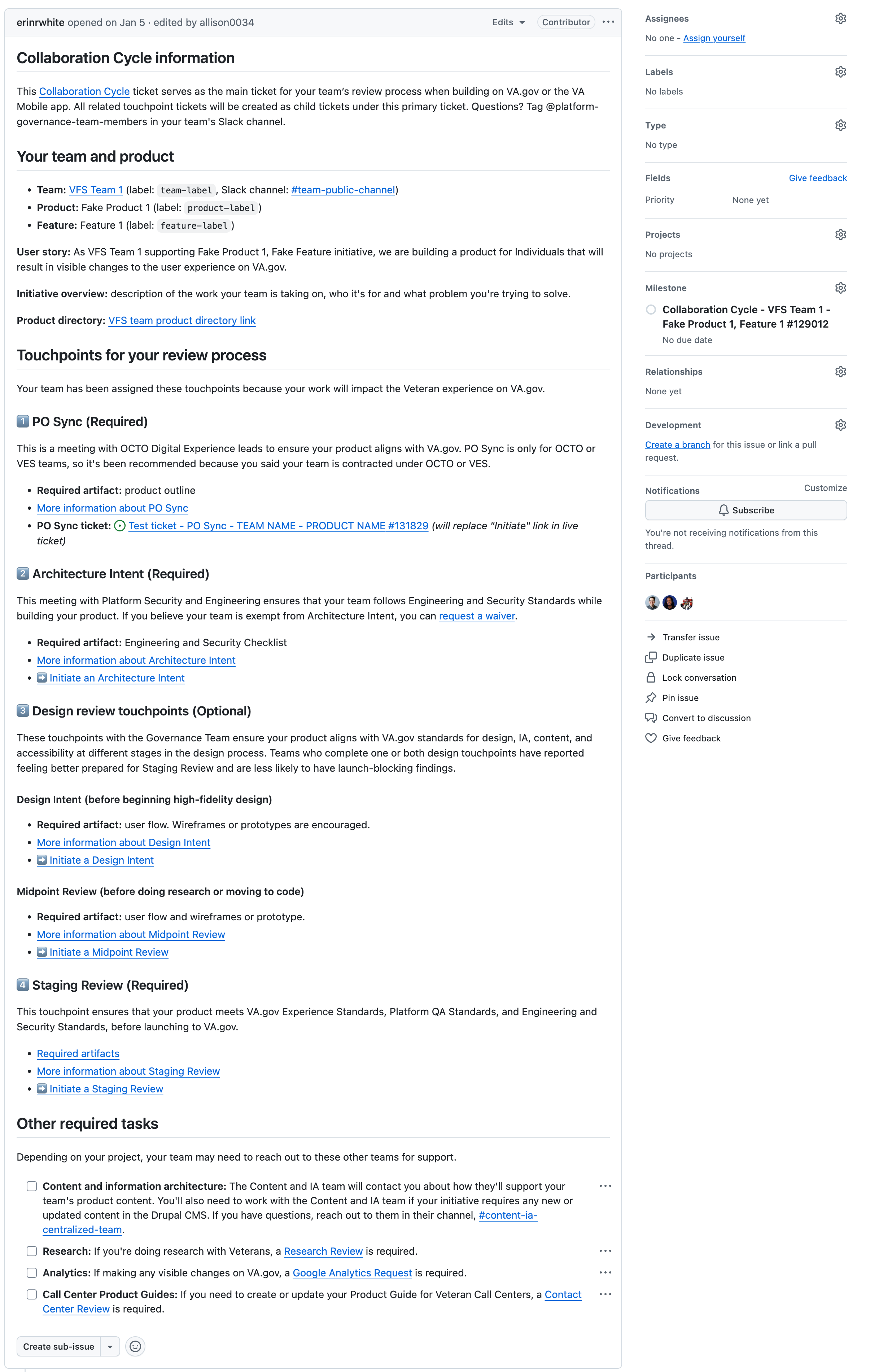
Ticket example after GitHub automation is complete
You will know the GitHub automation is complete when you see your request ticket update with assigned touchpoints. If this does not happen, reach out to the Governance Team on Slack #vfs-platform-support
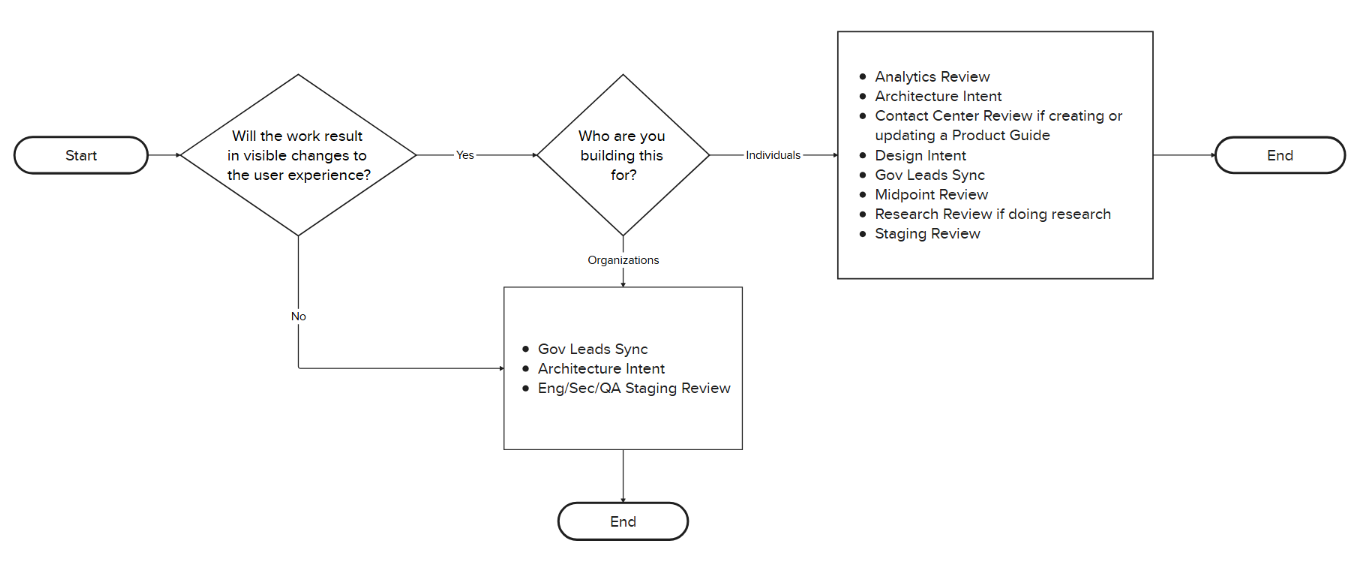
Collaboration Cycle touchpoints assignments flow
The complexity of a given product or feature determines which touchpoints product teams will participate in as they go through the collaboration cycle. During the kickoff process, consult this flow diagram to understand which touchpoints are applicable.
Completing the kickoff request ticket
Review our terms and definitions regarding products vs. features. Then, prepare to answer these questions in your Collaboration Cycle request ticket:
Team and product information
1. Your team name
Select your team’s name from the dropdown list. If your team isn’t listed, you need to first add your team to the teams manifest.
2. Product name
Include the name of the product you’re bringing through Collab Cycle. See terms and definitions on products vs. features for additional information.
3. Feature name
Include the name of the feature you’re bringing through Collab Cycle. See terms and definitions on products vs. features for additional information.
4. Initiative Overview
Briefly describe what you are building. This helps the Governance Team determine how to best support your product through the Collab Cycle.
5. Product Directory Link
Enter a URL for your product in the Product Directory. If your product isn't in the directory, or needs to be updated, you’ll need to request an update to the product directory.
6. GitHub label for product
Enter a label from the va.gov-team repo. Your product label must be different than your team label. The product label is required.
7. GitHub label for feature
Enter a label from the va.gov-team repo, if applicable. The feature label isn’t required.
Kickoff Questions
1. Who are you building this for?
This multiple-choice question offers two options:
-
Individuals (People using VA services directly: Veterans, caregivers, family members, survivors)
-
Organizations (People working for the VA or another organization in an official capacity: VA staff, contractors, Authenticated Reps)
We ask this question to determine if your product is Veteran-facing. At this time, only Veteran-facing products are supported by the design touchpoints of the Collaboration Cycle. Teams whose products are not Veteran-facing will still need complete the engineering touchpoints of the Collaboration Cycle.
2. Will your work result in visible changes to the user experience?
Examples of visible changes include:
-
Any changes that the user will see
-
Adding a new form, tool, or page
-
Modifying buttons, design elements, interactions, or page layouts
-
Reordering content, adding new calls to action, alert boxes, expandable sections, or error messages
Examples of no visible changes include:
-
Changes to code that the user won’t see
-
Changes to accessible labels (aria-label, aria-labelledby, aria-describedby)
Linking Artifacts
After completing the questions, you will need to link product artifacts to the ticket. It is the Product Manager’s responsibility to ensure the link to the Product Outline is added to the ticket. The product team is responsible for providing all relevant and up-to-date links, screenshots, images, and designs of the product's as-is version.
Help and feedback
-
Get help from the Platform Support Team in Slack.
-
Submit a feature idea to the Platform.