

Last Updated: March 23, 2026
When Sidekiq jobs fail and exhaust their retries, the job arguments are automatically logged to Datadog for debugging and monitoring. Unlike standard Rails request logging, where parameter filtering is applied, Sidekiq does not provide the same level of built-in PII filtering for job arguments.
This creates a risk: if sensitive data (e.g., emails, names, or other PII) is passed directly into job arguments, it can be unintentionally exposed in logs.
To mitigate this, Sidekiq::AttrPackage was introduced. Sidekiq::AttrPackage is implemented within the Vets-Api repository and is the standard mechanism for safely handling PII in background jobs, https://va.ghe.com/software/vets-api/blob/master/lib/sidekiq/attr_package.rb .
Approach
-
Sensitive attributes are stored securely in Redis.
-
Only a reference key (cache key) is passed as the Sidekiq job argument.
-
Jobs retrieve the actual data from Redis at runtime.
Outcome
-
Prevents PII from being logged in Datadog when jobs fail.
-
Keeps Sidekiq job arguments safe for logging and observability.
-
Aligns background job processing with our overall data protection standards.
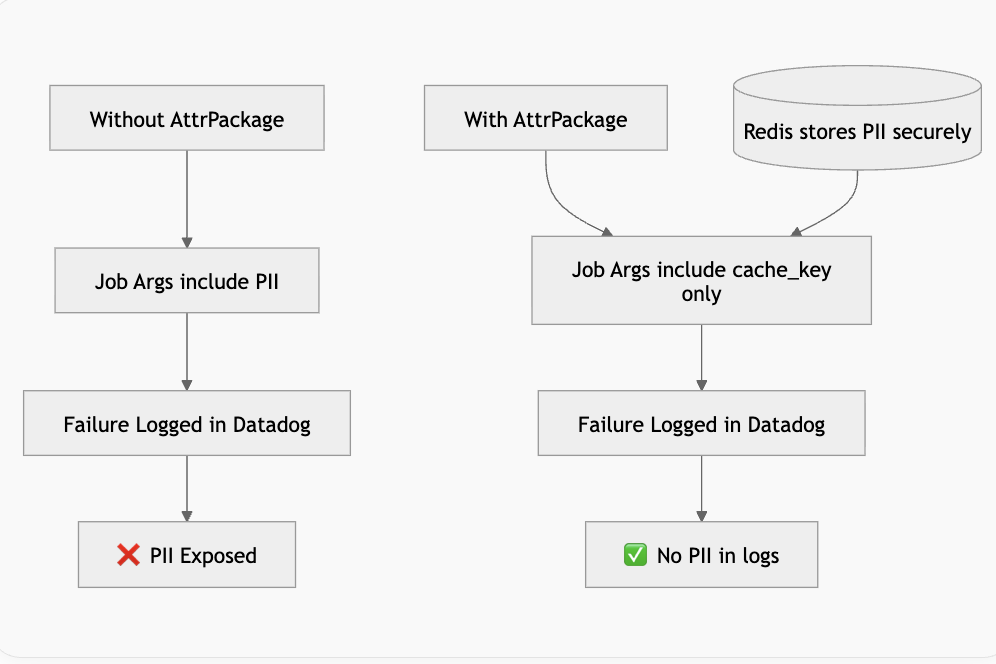
Key Security Boundary
❌ Without AttrPackage:
Sidekiq Args → { email: "user@example.com" } → Logged in Datadog
✅ With AttrPackage:
Sidekiq Args → { cache_key: "abc123" } → Safe to log
Redis → { email: "user@example.com" } → Never logged
Best Practices
Create once → Pass through → Delete once
Cache Key Lifecycle (Critical)
A cache_key must follow a strict lifecycle to prevent:
-
PII exposure
-
Redis memory leaks
-
Orphaned data
Rules:
-
A
cache_keyis created once at the entry point (Rails app). -
The same
cache_keymust be passed through all jobs/services. -
The
cache_keymust be deleted exactly once, regardless of outcome.
🚫 Do NOT Create Cache Keys in Jobs or Services
Creating new cache keys inside jobs leads to:
-
Orphaned PII in Redis
-
Broken traceability
-
Increased risk of leaks
❌ Anti-Patterns (MUST NOT DO)
1. Creating packages inside jobs
def perform(...)
  Sidekiq::AttrPackage.create(...) # ❌ NEVER
end
2. Deleting in ensure
ensure
  Sidekiq::AttrPackage.delete(cache_key) # ❌ breaks retries
end
3. Regenerating cache keys
def perform(cache_key)
  new_cache_key = Sidekiq::AttrPackage.create(cache_key) # BAD
end
4. Fallback to fetching PII outside AttrPackage
icn = attrs[:icn]
icn ||= get_icn(user_id) # ❌ weakens protection
✅ Correct
def perform(cache_key)
  data = Sidekiq::AttrPackage.find(cache_key)
end
🔁 Retries Must Reuse the Same Cache Key
-
Jobs and services should never generate a new cache key
-
The original
cache_keymust remain valid for the entire run and for retries
Why:
-
Sidekiq retries reuse the same job arguments
-
Creating new keys breaks consistency and leaks old data
🧹 Always Clean Up Cache Keys
A cache_key must be deleted in ALL execution paths:
✅ Required Cleanup Scenarios
-
Success
-
Failure (after retries exhausted)
-
Manual error handling
Recommended Pattern
Success Failure Clean Up - REQUIRED
def perform(cache_key)
  data = Sidekiq::AttrPackage.find(cache_key)

  # process job...
ensure
  Sidekiq::AttrPackage.delete(cache_key)
end
Retry Cache Key Clean up - REQUIRED for retries
  sidekiq_retries_exhausted do |msg, _ex|
    cache_key = msg['args'].first
     # process retries...

    Sidekiq::AttrPackage.delete(cache_key) if cache_key
  end
⚠️ Common Pitfalls to Avoid
|
Anti-Pattern |
Risk |
|---|---|
|
Creating cache keys in jobs |
Orphaned PII in Redis |
|
Not deleting cache keys on success |
Memory leak |
|
Only deleting on retries |
Keys persist on success/failure |
|
Only deleting on success |
Keys persist after failures |
|
Regenerating cache keys |
Lost reference to original PII |
⏳ (Optional but Recommended) Use TTL as a Safety Net
Even with proper cleanup, Redis keys should have a TTL:
-
Protects against unexpected job crashes
-
Prevents long-term PII retention
-
The default TTL is 7 days and should be reduced if the
cache_keyis not required for that duration.
Sidekiq::AttrPackage.create(data, ttl: 24.hours) # Set TTL to 24 hours
TTL is a fallback and NOT a replacement for explicit deletion.
Help and feedback
-
Get help from the Platform Support Team in Slack.
-
Submit a feature idea to the Platform.